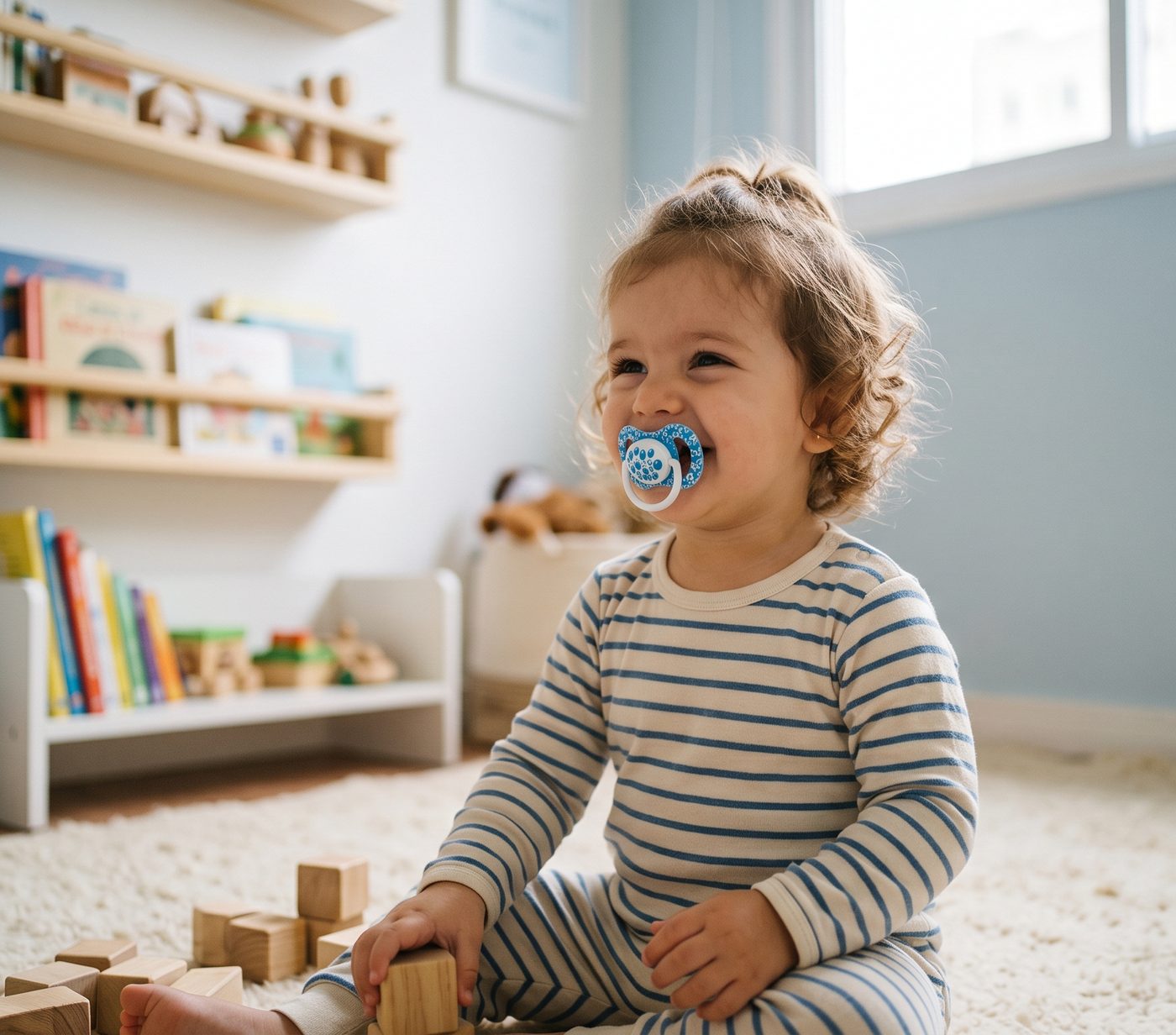
Yes, a pacifier can cause crooked teeth. The risk depends on three factors — the duration, frequency, and intensity of use. Up to age 2, fully removing the habit usually allows spontaneous correction. Between ages 3 and 4, continued use can already affect the bone structure of the face, requiring orthodontic follow-up.
This guide translates what pediatric dentistry proves about the pacifier's impact on the dental arch: how it changes a baby's mouth, what the age limit for stopping is, and how to wean off without trauma.
How Does a Pacifier Alter the Structure of a Baby's Mouth?
A baby's mouth is a malleable bone structure, still forming. During prolonged pacifier sucking, the cheek muscles press inward while the tongue is pushed down, no longer supporting the roof of the mouth. This imbalance of forces can lead to dental malocclusions.
The three most common changes
| Change | What happens |
|---|---|
| Anterior open bite | The upper and lower front teeth don't touch when biting — the most frequent change |
| Posterior crossbite | Narrow, deep palate (high-arched palate); the upper arch closes "inside" the lower one |
| Increased overjet | Front teeth project outward, raising the risk of fracture during falls |
Why Are Some Children Affected More Than Others?
The answer lies in the Graber Triad, a clinical concept used in orthodontics to assess each child's actual risk:
A child who uses the pacifier for just 10 minutes to fall asleep has a much lower risk of bone deformation than one who keeps it in their mouth all day long, including while playing and watching TV.
Does an Orthodontic Pacifier Solve the Problem?
Not on its own. Pacifiers with an anatomical nipple (flattened tip) reduce the initial impact on the alignment of the front teeth compared with the traditional round nipple — this has been shown in clinical studies.
What Is the Age Limit for Stopping the Pacifier?
How Do You Wean a Child off the Pacifier Without Trauma?
The pacifier served a real role in emotional regulation — removing it doesn't need to be abrupt.
-
Progressive restriction Limit use to the crib and bedtime. Don't leave the house with it; remove it as soon as the child falls into deep sleep.
-
Substitute stimuli Not every cry calls for sucking — it can be boredom, tiredness, or a need to be held. Offer a story, a song, or a transition object.
-
Playful strategies (age 2+) Trade the pacifier for a special toy on a memorable date, or make small holes in the tip of the silicone nipple — this removes the negative suction pressure and gradually reduces the child's interest.
Other Habits That Harm the Teeth
The pacifier is the most discussed habit, but it's not the only one that changes the position of the teeth and the shape of the roof of the mouth. The same logic from the Graber Triad applies: what determines the damage is mainly how long the habit lasts and how many hours a day it takes up.
| Habit | What it can cause | When it needs intervention |
|---|---|---|
| Finger-sucking | Open bite, upper teeth projection, narrow palate. Tends to deform more than a pacifier, because the finger is rigid | If it persists past age 3, and always past age 4 |
| Sweetened nighttime bottle | Early childhood cavities, especially in the upper incisors | Immediately, at any age |
| Mouth breathing | High-arched palate, open bite, inflamed gums from dry mouth, altered tongue posture | As soon as it's noticed — requires an ENT evaluation, not just a dentist's |
| Bruxism (teeth grinding) | Enamel wear, sensitivity, jaw pain upon waking | If there's visible wear, pain, or a persistent complaint |
| Nail-biting and chewing on objects | Edge wear, microfractures, joint overload | At any age, if it's frequent |
| Snacking on sugar throughout the day | Repeated acid attacks; how often you're exposed matters more than the total amount | Always — keep sweets to set times |
Finger-sucking: why it's harder to break than the pacifier
A pacifier can be taken out of circulation. A finger can't. Punishing, scolding, or applying bitter-tasting substances tends to increase anxiety and reinforce the habit. The path is the same as pacifier weaning: identify the triggers, offer a substitute in those moments, and reinforce every bit of progress. If the habit continues past age 4, the pediatric dentist may recommend appliances that act as a reminder.
Mouth breathing deserves extra attention
Sleeping with the mouth open, snoring, drooling on the pillow, waking up tired, and frequent dark circles under the eyes are signs. The cause is usually in the airways — adenoids, tonsils, rhinitis — and the effect on facial growth shows up before parents connect the two. The evaluation needs to be a joint one: an ear, nose, and throat specialist together with the pediatric dentist.
When to Seek Professional Follow-up
Seek guidance if:
- The child closes their mouth and the teeth don't fit together correctly
- The habit persists past age 3
- Weaning is causing intense anxiety in the family routine
Practical Summary
| Question | Direct answer |
|---|---|
| Does a pacifier crook the teeth? | Yes, if use is intense, frequent, and prolonged |
| Until when is it safe to use one? | Ideally, until age 2 |
| Does an orthodontic pacifier prevent the problem? | It reduces the initial impact, but doesn't replace weaning |
| What happens after age 4? | The problem becomes bone-related, requiring orthopedic/orthodontic treatment |
| Do crooked teeth straighten out on their own? | Only if the habit is removed by age 2 |
📘 Keep following your child's oral development
- Habits that harm oral health — pacifiers, nighttime bottles, and fluorosis explained
- The importance of primary teeth — why care for baby teeth even though they're temporary
- Preparing your child for the first dental visit — a step-by-step guide to reducing anxiety
Sources and references
Content based on pediatric dentistry. This article is for educational purposes and does not replace a consultation with an oral health professional. For evaluation and diagnosis, see a pediatric dentist.